
A few years ago, "sustainable umbrella" was a niche selling point. Today it's a procurement checkbox. Retail buyers sourcing private-label product are fielding ESG questions from their own buyers; brand managers are under pressure to hit sustainability commitments in annual reports; and large-format retailers are tightening supplier requirements around chemical safety and recyclability. The umbrella category — historically overlooked in sustainability conversations — is catching up fast.
This guide is written for buyers, brand managers, and sourcing teams, not end consumers. It explains what the material claims actually mean, how to verify them before placing an order, and what genuinely eco-friendly umbrellas look like at a manufacturing level in 2026.

The global umbrella market was valued at over USD 5.6 billion in 2024, with growth projected through the next decade. But the more meaningful shift isn't in volume — it's in what buyers are willing to pay a premium for and, increasingly, what they're refusing to accept.
Three pressures are converging simultaneously. First, chemical safety regulations in Europe (particularly around PFAS) are expanding, and brands that source umbrellas with fluorochemical water-repellent coatings face compliance exposure in key markets. Second, many retailers have made public-facing sustainability commitments that require them to audit and disclose supplier practices — which means the certifications your manufacturer holds now affect whether you can even get on the shelf. Third, consumers in the premium segment are willing to pay more for products they trust.
The result: sustainable umbrellas are no longer a separate SKU you add to your range for optics. They're becoming the standard for the mid-to-premium tier.

The sustainable materials landscape has matured considerably. Not every claim holds up under scrutiny, so it's worth distinguishing between materials with a real track record and those that are still more concept than product.
Recycled PET — fabric made from post-consumer plastic bottles — is now the most widely adopted eco material in umbrella canopies. A standard folding umbrella canopy uses roughly 8 to 15 bottles' worth of RPET, depending on canopy size. The material performs comparably to virgin polyester in terms of UV resistance, color fastness, and weatherproofing. The key is ensuring the supplier can provide GRS (Global Recycled Standard) certification for the fabric, which verifies the recycled content claim through the supply chain. Without that certification, "recycled" is just marketing copy.
Bamboo handles are a solid, well-established alternative to plastic. Bamboo is fast-growing, requires no pesticides, and the finished material is durable enough for daily use. FSC-certified wood handles (from sustainably managed forests) serve the same function for buyers who want a warmer, more premium aesthetic. Both materials are genuinely lower-impact than virgin plastic handles and are easy to validate via supplier documentation.
Waxed cotton umbrellas and waxed canvas umbrellas occupy a specific niche: the premium, heirloom-quality segment where longevity is the sustainability argument. A well-made waxed canvas umbrella can last 10–20 years with occasional re-waxing, which means it generates far less waste over its lifetime than a cheaper synthetic alternative replaced every two or three years. They're heavier and more expensive to produce, but for certain brand positions they're the right call.
Fully biodegradable umbrellas remain technically complex. An umbrella has many components — canopy fabric, frame, ribs, handle, tip, runner — and getting all of them to biodegrade without compromising durability is still a work in progress for most manufacturers. More practical today is partial biodegradability: bamboo handles, natural-fiber canopies, and metal frames that can be separated and recycled at end of life. Be cautious of blanket "biodegradable umbrella" claims without component-level detail.
Coffee bio-composite handles, mycelium leather components, and atmospheric-water-harvesting canopies appear in industry press but are not yet available at commercial MOQ from mainstream manufacturers. If a supplier quotes these as standard options, ask for samples and lead times — in most cases they can't deliver at scale.
PFAS (per- and polyfluoroalkyl substances) are a class of synthetic chemicals used widely in water-repellent fabric coatings. They're extremely durable — which is exactly why they're a problem. PFAS do not break down in the environment or in the human body, earning them the name "forever chemicals." Regulatory pressure on PFAS is increasing across the EU, UK, and increasingly in the US.
For umbrella buyers, the relevant question is: does my supplier's water-repellent treatment contain PFAS, and can they prove it doesn't?
The gold standard for PFAS-free umbrella certification in the industry is third-party testing by SGS or equivalent accredited labs. The test specifically looks for PFOA, PFOS, and related compounds. Manufacturers who can provide SGS test reports for their PFAS-free fabric coatings are giving you auditable documentation — not just a claim.
Non-toxic, PFAS-free coatings using bio-based or silicone-based DWR (durable water repellent) treatments now match fluorochemical performance in most real-world conditions. If a supplier insists that PFAS-free coatings can't hold up, they're working with outdated chemistry.

RPET is the most common eco material claim in the umbrella industry right now, which means it's also the most frequently misused. Here's what to ask:
1. Can the supplier provide GRS certification for the fabric?
The Global Recycled Standard is the most widely recognized third-party certification for recycled content. It traces the material from post-consumer waste through processing to the finished fabric. If a supplier can't provide a GRS certificate or the certificate number, the recycled content claim is unverified.
2. What percentage of the fabric is RPET?
Some fabrics are blended — 50% RPET, 50% virgin polyester, for example. This is still better than 100% virgin, but it's worth knowing what you're actually communicating to your end customers.
3. What about the rest of the umbrella?
An RPET canopy on a virgin plastic handle doesn't tell the whole product story. For buyers building a coherent sustainability narrative, it's worth specifying RPET fabric plus bamboo or FSC wood handle as a package.
These terms appear frequently in product marketing but have very different levels of standardization behind them.
Carbon neutral umbrella brands typically achieve this through a combination of operational efficiency and carbon offset purchasing. For a manufacturer, this means measuring Scope 1 and Scope 2 emissions, reducing where possible, and offsetting the remainder via verified programs (Gold Standard, VCS). Ask which offset scheme they use and whether the claim covers manufacturing emissions only or the full supply chain.
Plastic-free umbrella claims require a material-by-material check. Metal frames, bamboo handles, and natural-fiber canopies can get you close — but the runner, tips, and cap are often overlooked. A genuinely plastic-free umbrella is difficult to achieve at scale and usually comes at a significant cost premium.
Non-toxic umbrella most commonly refers to chemical safety testing — REACH compliance, Oeko-Tex certification, or PFAS-free test reports. These are more tangible and auditable than some other eco claims, and they're particularly important if your product will be used by children or sensitive users.
The most defensible position for a buyer is to build your sustainability claims around third-party-verified certifications rather than self-declared labels. Certifications can be shown to retailers, put in product copy, and stand up to scrutiny. Self-declared claims cannot.
TopUmbrella (Sishun Umbrella Co., Ltd.) manufactures from facilities in Huizhou, China and Cambodia. The Cambodia facility has completed Higg FEM (Facility Environmental Module) verification and holds SLCP VRF status — which means buyers subject to social and environmental audit requirements can reference these existing assessments rather than initiating redundant audits. This directly reduces sourcing costs and timelines for ESG-compliant buyers.
The eco product range covers four main material approaches: RPET fabric, PFAS-free fabric, bamboo components, and straw composite frames. All eco material claims are backed by supplier certification documentation available on request.
| Product | Eco Credentials | Best For | Eco Rating |
|---|---|---|---|
 TU2125 Straw Composite Umbrella TU2125 Straw Composite Umbrella |
Agricultural waste fiber frame; biodegradable components; no virgin plastic in structure | Brands targeting plastic-free positioning; gift and lifestyle retail | ⭐⭐⭐☆ |
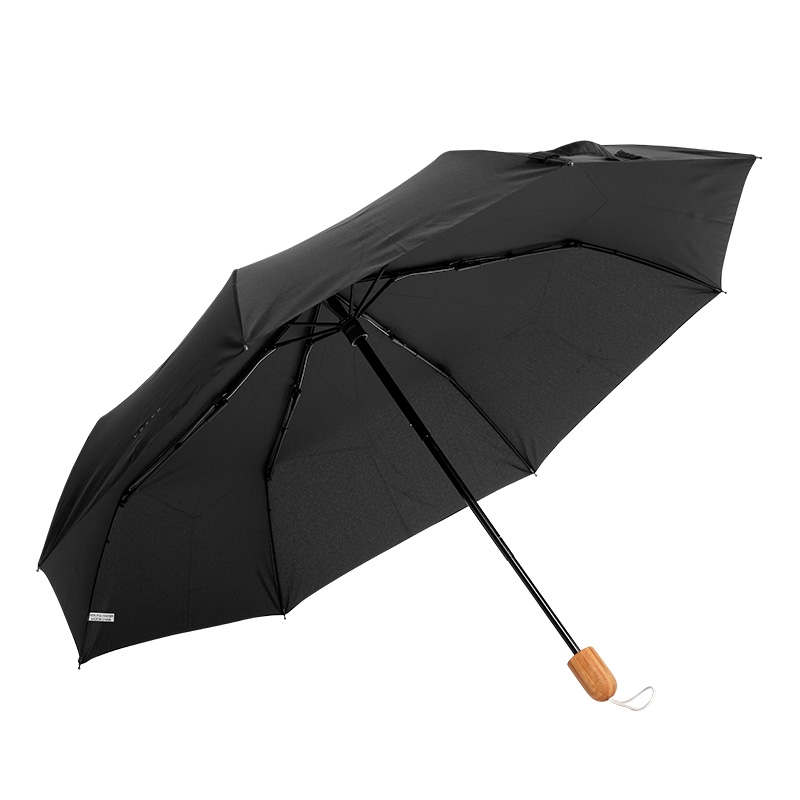 TU3069 RPET + Bamboo Folding Umbrella TU3069 RPET + Bamboo Folding Umbrella |
GRS-certifiable RPET canopy (approx. 8–10 bottles per unit); bamboo handle; lightweight at 250g | Corporate gifting, retail private label, sustainable everyday carry | ⭐⭐⭐⭐ |
 TU3005 SGS-Certified PFAS-Free Folding Umbrella TU3005 SGS-Certified PFAS-Free Folding Umbrella |
SGS-tested PFAS-free DWR coating; REACH compliant; suited to EU market chemical requirements | EU/UK retail, brands with chemical safety commitments, non-toxic product ranges | ⭐⭐⭐⭐ |
 Bamboo + RPET Classic Stick Umbrella Bamboo + RPET Classic Stick Umbrella |
Full bamboo frame; RPET canopy; designed for extended product life — suitable for longevity-based sustainability narrative | Premium retail, department stores, brands emphasizing durability over disposability | ⭐⭐⭐⭐ |
Custom eco configurations are available — including RPET fabric with PFAS-free coating, bamboo handle with metal-free tips, and custom recycled packaging. Sample development includes 3D mockups and pre-production samples before full-run commitment.
At minimum: GRS certificate for any RPET fabric claim, SGS or equivalent lab test report for any PFAS-free claim, and FSC certificate for wood or bamboo components. For suppliers making broader sustainability claims (carbon neutral, zero waste), ask which third-party scheme verifies those claims. Facility-level certifications like Higg FEM or BSCI give additional confidence in factory practices.
Yes, for standard use conditions. Modern bio-based and silicone DWR treatments repel water effectively in rain scenarioses. They may re-wet slightly faster than C8-era fluorochemical coatings in prolonged heavy rain, but for most consumer use cases the performance difference is negligible. The coating can also be reapplied if needed, which extends product life — an additional sustainability benefit.
MOQs for RPET and PFAS-free variants are comparable to standard products — typically 500 to 1,000 units per SKU depending on configuration. Bamboo handle models may have slightly higher MOQs due to raw material sourcing. Custom eco configurations (e.g., branded RPET fabric with specific Pantone + bamboo handle) generally require 1,000 units minimum for viable production economics.
Lead with the certification, not the claim. "SGS-certified PFAS-free coating" is more credible than "eco-friendly water repellent." "GRS-certified RPET fabric made from 10 recycled plastic bottles" is more specific and compelling than "made with recycled materials." Buyers who can provide you with documentation can also provide product-level language you can use in retail copy.
Technically, yes — RPET is still a synthetic polymer. The sustainability argument is that it diverts post-consumer plastic waste from landfill or ocean environments and gives it a second use life. A plastic-free umbrella (using natural-fiber canopy, bamboo or wood frame, metal ribs) eliminates synthetic polymers almost entirely, but at higher cost and with some durability trade-offs. Which approach fits your brand positioning depends on what you're trying to communicate to your customer.
Ask both for the same documentation and compare what they can actually produce. A supplier with Higg FEM verification or SLCP VRF status has already gone through an independent assessment of their environmental and social practices — that's meaningfully more credible than a self-completed questionnaire. Lead time on samples is also informative: a supplier who can deliver a PFAS-free sample quickly has it as a real product, not a catalogue listing.
TopUmbrella is an OEM/ODM umbrella manufacturer with production facilities in Huizhou, China and Cambodia. For sourcing enquiries, sample requests, or certification documentation, contact sales@topumbrella.com or visit the contact page.


